


OCM Dimensions is a landmark Bitcoin Ordinals project: high-resolution, interactive 3D generative art rendered entirely from on-chain code. Launched in February 2023 by the OnChainMonkey team, it proved—early and definitively—that Bitcoin can support sophisticated, permanent digital art without off-chain dependencies.
- Fully on-chain, interactive 3D generative art on Bitcoin
- Each artwork rendered live from code, not stored images
- Uses recursion, compression, and shared on-chain libraries
- Historic early sats + early Ordinals experimentation
- Open-source tools included to build your own Bitcoin-native art
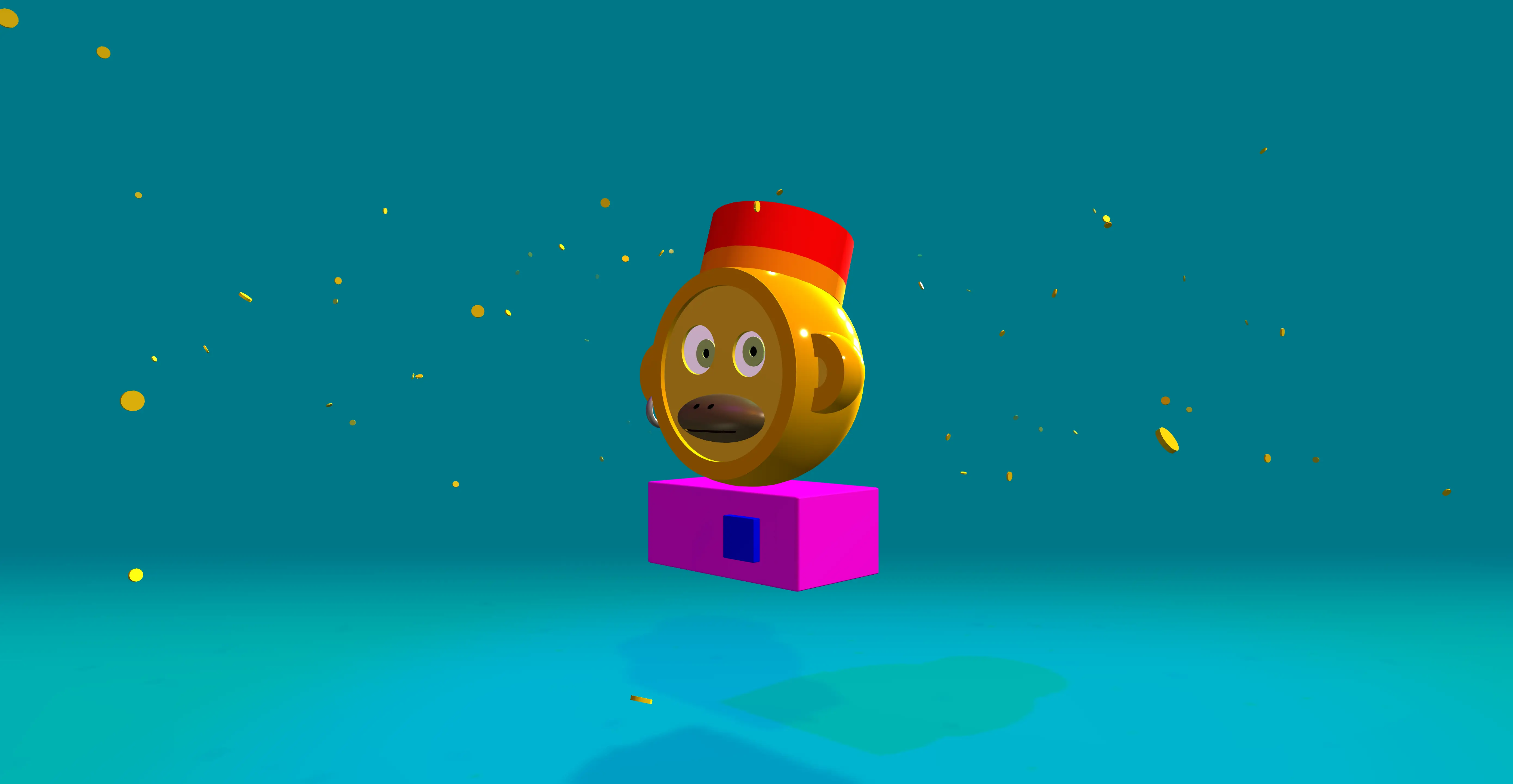
Example OCM Dimensions artwork. Each piece is a live-rendered 3D animated sculpture generated entirely from code inscribed on Bitcoin.
- Why OCM Dimensions Matters
- Historical Context: Bitcoin Ordinals & On-Chain Art
- Technical Firsts
- About This Repository
- Quick Start
- Repository Structure
- Inscribing on Bitcoin
- Contributing
- Philosophy
- Further Reading
OCM Dimensions expanded the boundaries of what was thought possible on Bitcoin:
-
High-fidelity 3D art Each piece is a real-time rendered 3D animation that adapts to any screen resolution, including 4K+ displays.
-
Extreme on-chain efficiency Each artwork is under ~1KB despite its visual complexity—made possible through generative code, compression, and recursion.
-
Protocol-level permanence No IPFS. No APIs. No servers. Everything needed to render the art lives on Bitcoin itself.
-
Bitcoin-native provenance Early parent-child inscription patterns define collection membership and authenticity directly on-chain.
OCM Dimensions helped establish Bitcoin Ordinals as a serious medium for generative and conceptual digital art.
Bitcoin Ordinals allow individual satoshis to carry arbitrary data—turning the smallest unit of Bitcoin into a permanent digital artifact.
However, Bitcoin’s block space is scarce and expensive. Early assumptions were that only simple images or text could be inscribed sustainably.
OCM Dimensions challenged that assumption.
By combining:
- Generative art (code instead of images),
- Compression (gzip + base64),
- Recursion (shared on-chain libraries: Three.js, p5.js),
OCM Dimensions demonstrated that complex, interactive, high-resolution art could live entirely on Bitcoin.
Many techniques now considered standard in advanced Ordinals development—recursive calls, shared libraries, parent-child provenance—were first demonstrated publicly at scale in OCM Dimensions.
Part of the art of Dimensions is the concept of being a seed in a growing network of art on Bitcoin. Each new artwork created that is enabled by Dimensions is a new branch in the growing on-chain "tree" of networked art. Now, after two years, the tree has grown into a forest of art works by numerous artists and thousands of works (many still waiting to be discovered!). OCM Dimensions is one of the most linked inscriptions on Bitcoin.
OCM Dimensions pioneered recursion with code on Bitcoin, allowing inscriptions to call other inscriptions at render time. This made modular, composable on-chain software possible.
Compressed versions of:
- Three.js (3D rendering)
- p5.js (generative art)
- fflate (compression)
were inscribed once and reused across artworks—dramatically reducing size and enabling rich visuals.
A parent inscription defines the collection. Child inscriptions define individual artworks. Authenticity and membership are verifiable at the protocol level.
Early Dimensions pieces were inscribed on satoshis mined in January 2009, embedding the work directly into Bitcoin’s earliest history.
The first fully on-chain random reveal mechanisms on Bitcoin, ensuring fair distribution without off-chain randomness. Originally thought impossible with immutable inscriptions.
This repository contains the open-source tooling developed for OCM Dimensions, and available for everyone to use.
It enables artists and developers to:
- Build generative and interactive Ordinals
- Compress HTML/JS for Bitcoin constraints
- Reuse on-chain libraries via recursion
- Create rich visuals without protocol changes
These tools are production-proven by OCM Dimensions itself.
The On-chain library inscriptions:
These inscriptions are the foundation of the workflow in this repo. You use recursion (fetching on-chain content from within your inscription) to load the libraries at render time.
- OCM Dimensions (fflate + Three.js):
2dbdf9ebbec6be793fd16ae9b797c7cf968ab2427166aaf390b90b71778266abi0 - p5.js library:
255ce0c5a0d8aca39510da72e604ef8837519028827ba7b7f723b7489f3ec3a4i0
Direct links:
- https://ordinals.com/inscription/2dbdf9ebbec6be793fd16ae9b797c7cf968ab2427166aaf390b90b71778266abi0
- https://ordinals.com/inscription/255ce0c5a0d8aca39510da72e604ef8837519028827ba7b7f723b7489f3ec3a4i0
You will need the following installed on your machine:
- Node.js and npm. You can download these from here.
makecommand. This is usually pre-installed on Unix-based systems. For Windows, you can use a utility like Make for Windows.
You can download the tools directly from this GitHub repository. Simply click on the 'Code' button on this page and then click 'Download ZIP'. Once downloaded, unzip the file and navigate to the resulting directory in your terminal.
If you have git installed, you can also clone this repository by running:
git clone https://github.com/metagood/OCM-Dimensions.git
cd OCM-DimensionsPick the workflow that matches your project:
- Browser UI (no terminal needed): open
tools/browserUI/index.htmlin your browser and use the Compile button to generate a ready-to-inscribe page. - Three.js: use
tools/threejsto compress your scene logic and auto-load the on-chain Three.js + fflate bundle. - p5.js: use
tools/p5jsto compress your sketch and auto-load the on-chain p5.js library. - Compress HTML: use
tools/compress-htmlwhen you already have a full HTML page you want to gzip+base64 and stream on-chain.
For guided walkthroughs, start in tutorials/README.md.
- Navigate to the
tools/compress-htmldirectory withcd tools/compress-html. - Place your
.htmlfile in theinputdirectory. - Run
make clean && makein the terminal. - Your compressed file will be
index.html(for inscribing) andindex.local.html(for local preview). - Open
index.local.htmlin a browser to test locally with the Ordinals content URLs already in place.
- Navigate to the
tools/threejsdirectory withcd tools/threejs. - Minify your
02_main.jsfile and save it ascompressed-inputs/02_main.min.js.- If you have
minifyinstalled, runminify 02_main.js > compressed-inputs/02_main.min.jsin the terminal. - If you don't have
minify, just put the js code incompressed-inputs/02_main.min.jsdirectly.
- If you have
- Run
make clean && makein the terminal. - Your final files will be
index.html(for inscribing) andindex.local.html(for local preview). - Open
index.local.htmlin a browser to test locally with the Ordinals content URLs already in place.
- Navigate to the
tools/p5jsdirectory withcd tools/p5js. - Put your js code in
input/02_main.js. - Run
make clean && makein the terminal. - Your final files will be
index.html(for inscribing) andindex.local.html(for local preview). - Open
index.local.htmlin a browser to test locally with the Ordinals content URLs already in place.
The make targets now generate index.local.html for each workflow with https://ordinals.com prefilled for the content fetches. Use it for local preview, and inscribe index.html as-is.
Run a smoke test build of all three command-line workflows:
./scripts/run-smoke-tests.sh- tools/compress-html/ - Compress a single HTML file using gzip and base64.
- tools/threejs/ - Helper scripts for Three.js projects.
- tools/p5js/ - Helper scripts for p5.js projects.
- tools/browserUI/ - In-browser interface to bundle code with selected libraries.
- tools/compress-html/examples/ - Samples demonstrating larger pieces of content.
- tools/compress-html/onepage/ - Example output from the browser UI.
- tutorials/ - Step-by-step guides for the Three.js, p5.js, and compressed HTML workflows.
- scripts/ - Repository smoke tests.
Each directory includes a README with specific build instructions.
Once your final index.html is ready, inscribe it using any Ordinals-compatible wallet or service.
Your artwork will render directly from on-chain code—no external infrastructure required.
Issues, pull requests, and improvements are welcome. This repo exists to expand what’s possible for art and software on Bitcoin.
OCM Dimensions treats Bitcoin as:
- A monetary system
- A permanence layer
- A medium for generative art
By embracing Bitcoin’s constraints, it reveals new creative possibilities—where art, code, and provenance converge at the protocol layer.